Showing posts with label TechCrunch. Show all posts

Tuesday, April 24, 2018

8VC has closed its second early-stage fund, seemingly with an eye on logistics and biotech

8VC, the early-stage, San Francisco-based venture firm founded in 2015 by serial entrepreneur Joe Lonsdale and four other general partners, has closed it second early-stage venture fund with $640 million in commitments, says one of its investors.

The fund comes roughly two years after the firm closed its debut fund with $425 million, along with a separate, $50 million seed fund. A couple of years ago, 8VC also quietly raised a late-stage “coinvest” fund that it closed with roughly $400 million in capital commitments, meaning its total assets under management are currently around $1.5 billion.

We’d talked with Lonsdale last year about 8VC, whose mantra is simply “The world is broken; let’s fix it.”

Already at that time, the firm had invested in Synthego, a genetic engineering startup that provides scientists with genetic material used in their CRISPR research, and Color Genomics, a company whose genetics services help its customers understand their risk for the most common hereditary cancers.

It also counts among its founding partners Kimmy Scotti, who has led investments in uBiome, Blink Health and Honor Elder Care on its behalf.

Now the firm appears to be beefing up its focus on biotech. One clue toward this end: It now features a section at its site titled “Tackling the bio-IT wave,” where it lists eight areas of emerging technology that it’s tracking, and highlights seven of its related startup bets, including Mantra Bio. The startup describes itself as a deep data platform for the study of exosomes, which are small lipid vesicles — air- or fluid-filled cavities — that are excreted from cells and which deliver information that Mantra plans to use to come up with new drug therapies.

8VC also brought aboard as an advisor Andrew Witty, the former long-serving CEO of drug giant GlaxoSmithKline. (Witty is also a venture partner with the life sciences investment firm Hatteras Venture Partners.)

In the meantime, 8VC also seems to be focusing more on logistics. For example, another recent addition to its network of advisors is Chris Sultemeier, who’d previously spent 28 years at Walmart, leaving as its executive vice president of logistics in May of last year.

8VC also earlier this month co-invested in a deal with Schneider National, a publicly traded company that sells truckload, intermodal and logistics services. The two had partnered to invest in Platform Science, a company that says it’s creating an IoT system for the transportation industry.

Either way, the young venture firm looks to have built a strong portfolio to date, with other bets that include the highly valued mobile commerce app Wish, and the health insurance company Oscar, which just last month announced $165 million in new funding led by Founders Fund. The round also included Capital G, which is Alphabet’s growth-stage venture arm, and its life sciences business Verily.

Like every venture firm, 8VC also has its more controversial bets. Blink, a company at work on a discount prescription service, has been embroiled in numerous lawsuits in its four-year history. Most recently, the firm filed suit against a pharmacy startup that it views as an “unlawful copycat scheme.”

Lonsdale also invested personally in Hyperloop One, which is trying to develop a high-speed transportation technology. The outfit was notoriously dysfunctional at its start, and it remains unclear if the company can become a sustainable concern with the financial help of billionaire Richard Branson, whose Virgin Group became involved with the company last fall.

8VC’s other founding partners include Alex Kolicich, Jake Medwell, and Drew Oetting.

Axios was first to report that 8VC had closed its newest fund.


from TechCrunch https://ift.tt/2HUlF8t

Thursday, April 19, 2018

EarthNow promises real-time views of the whole planet from a new satellite constellation

A new space imaging startup called EarthNow aims to provide not just pictures of the planet on demand, but real-time video anywhere a client desires. Its ambition is matched only by its pedigree: Bill Gates, Intellectual Ventures, Airbus, SoftBank and OneWeb founder Greg Wyler are all backing the play.

Its promise is a constellation of satellites that will provide video of anywhere on Earth with latency of about a second. You won’t have to wait for a satellite to come into range, or worry about leaving range; at least one will be able to view any area at any given time, so they can pass off the monitoring task to the next satellite over if necessary.

Initially aimed at “high value enterprise and government customers,” EarthNow lists things like storm monitoring, illegal fishing vessels (or even pirates), forest fires, whale tracking, watching conflicts in real time and more. Space imaging is turning into quite a crowded field — if all these constellations actually launch, anyway.

The company is in the earliest stages right now, having just been spun out from years of work by founder and CEO Russell Hannigan at Intellectual Ventures under the Invention Science Fund. Early enough, in fact, that there’s no real timeline for prototyping or testing. But it’s not just pie in the sky.

Wyler’s OneWeb connection means EarthNow will be built on a massively upgraded version of that company’s satellite platform. Details are few and far between, but the press release promises that “Each satellite is equipped with an unprecedented amount of onboard processing power, including more CPU cores than all other commercial satellites combined.”

Presumably a large portion of that will be video processing and compression hardware, since they’ll want to minimize bandwidth and latency but don’t want to skimp on quality. Efficiency is important, too; satellites have extremely limited power, so running multiple off-the-shelf GPUs with standard compression methods probably isn’t a good idea. Real-time, continuous video from orbit (as opposed to near-real-time stills or clips) is as much a software problem as it is hardware.

Machine learning also figures in, of course: the company plans to do onboard analysis of the imagery, though to what extent isn’t clear. It really makes more sense to me to do this on the ground, but perhaps a first pass by the satellite’s hardware will help move things along.

Airbus will do its part by actually producing the satellites, in Toulouse and Florida. The release doesn’t say how many will be built, but full (and presumably redundant) Earth coverage means dozens at the least. But if they’re mass-manufactured standard goods, that should keep the price down, relatively speaking anyway.

No word on the actual amount raised by the company in January, but with the stature of the investors and the high costs involved in the industry, I can’t imagine it’s less than a few tens of millions.

Hannigan himself calls EarthNow “ambitious and unprecedented,” which could be taken as an admission of great risk, but it’s clear that the company has powerful partners and plenty of expertise; Intellectual Ventures doesn’t tend to spin something off unless it’s got something special going. Expect more specifics as the company grows, but I doubt we’ll see anything more than renders for a year or so.


from TechCrunch https://ift.tt/2HekDXW

Wednesday, April 18, 2018

New York launches a fact-finding inquiry into Coinbase, Binance and other exchanges

As cryptocurrencies continued shaking off their April hangover, the state of New York is trying to figure out what to do with this whole coin thing.

On Tuesday, New York Attorney General Eric Schneiderman announced something called the Virtual Markets Integrity Initiative, a state-level effort to examine the policies and practices of the major cryptocurrency exchanges. Schneiderman’s office emphasized to TechCrunch that the endeavor is a “fact-finding inquiry” and not an “investigation” as it’s not apparent there is any wrongdoing.

“With cryptocurrency on the rise, consumers in New York and across the country have a right to transparency and accountability when they invest their money. Yet too often, consumers don’t have the basic facts they need to assess the fairness, integrity, and security of these trading platforms,” Schneiderman said.

“Our Virtual Markets Integrity Initiative sets out to change that, promoting the accountability and transparency in the virtual currency marketplace that investors and consumers deserve.”

Schneiderman’s office is often early to defend consumer rights in the state of New York, so the cryptocurrency inquiry is very in line with the kind of work his office already does on behalf of New York state residents.

The attorney general’s office addressed a standard questionnaire to 13 cryptocurrency platforms, from the biggest names in the business to more obscure exchanges:

  • Coinbase, Inc. (GDAX)
  • Gemini Trust Company
  • bitFlyer USA, Inc.
  • iFinex Inc. (Bitfinex)
  • Bitstamp USA Inc.
  • Payward, Inc. (Kraken)
  • Bittrex, Inc.
  • Circle Internet Financial Limited (Poloniex LLC)
  • Binance Limited
  • Elite Way Developments LLP (Tidex.com)
  • Gate Technology Incorporated (Gate.io)
  • itBit Trust Company
  • Huobi Global Limited (Huobi.Pro)

The letter seeks basic information about the company’s operations, broken down across eight major categories. Those questions span from basic inquiries about ownership to anti-money laundering precautions to a request for a detailed breakdown of the fees that consumers might incur. You can read the full text of the “Virtual Markets Integrity Initiative Questionnaire” here.

Again, the letter is a broad, standardized fact-finding mission, not an investigation based on specific knowledge. Schneiderman’s office clarified that the initiative seeks to illuminate any potential for market manipulation, abrupt trade outages that go unexplained and problems customers have withdrawing funds, among other cryptocurrency trader headaches. Still, it’ll tap into some thorny issues (money laundering, anyone?) that some exchanges might not yet have a proper way of handling. Ultimately they hope to use that information to make these platforms more fair and transparent for consumers, regulators and investors alike.

While anxious bullish investors might see the New York inquiry as a threat, many of the relevant exchanges are taking it in stride so far (at least so they say), even applauding the inquiry’s effort to create more transparency that could pave the wave for thoughtful rather than heavy-handed regulation.


from TechCrunch https://ift.tt/2vnc0Vl

Former DreamWorks exec Shawn Dennis joins GoldieBlox as president

GoldieBlox, a startup looking to get girls hooked on engineering and other STEM fields, has hired Shawn Dennis as its first president.

Dennis was most recently the head of brand and franchise development at DreamWorks Animation and also worked as the chief marketing officer at Mattel’s American Girl. She’s also been on the GoldieBlox board of directors since 2016 — founder and CEO Debbie Sterling told me she’s been “not-so-secretly hoping all along that one day Shawn would come and help me run this thing.”

Sterling said that while GoldieBlox is usually described as a toy company, she’s always had a vision for the Goldie character to become someone who would “inspire girls around the world.”

“I started it really as a social mission: I wanted to close the gender gap in STEM,” she said.

And yes, selling toys where girls can build their own machines is part of that mission, but so is the GoldieBlox YouTube channel and a partnership to produce chapter books with Random House.

Part of Dennis’ role at GoldieBlox will be to lead licensing and partnerships (apparently there’s an animated show in the works, as well) and to create what she described as “an ecosystem with girls at the center.” She added that things like YouTube are key for helping the company open “two lanes of communication,” so that it’s not just talking to parents but girls as well.

“It’s time again to reinvent what girlhood means,” Dennis said.

In addition to handling licensing, she said she’ll be managing much of the company’s day-to-day operations, freeing Sterling to focus on the long-term vision and on advocating for that vision. Dennis’ tenure at both DreamWorks (where she was involved in launching franchises like Trolls) and American Girl has given her plenty of experience with building brands for girls, but she added,” I will be running the business and building the business. I will not be the face of the company — that needs to be Debbie.”


from TechCrunch https://ift.tt/2H9nTQ1

Q1 2018 global diversity investment report: Investing trends in female founders

In this report, we look at venture and seed investment trends in female-founded startups over the last five quarters. For this time period, we look at more than 9,119 venture deals and 6,802 seed deals for companies with founders associated.

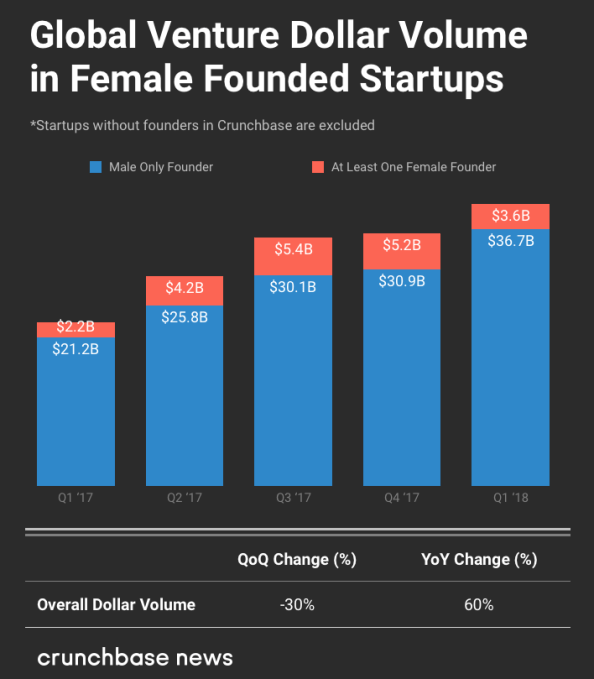
To begin, $3.6 billion was invested in companies with at least one female founder in Q1 2018. That result was up 60 percent from Q1 2017’s $2.2 billion tally but down from Q4 2017 by 30 percent. We fully expect this amount to go up as more fundings are added for the quarter retroactively.

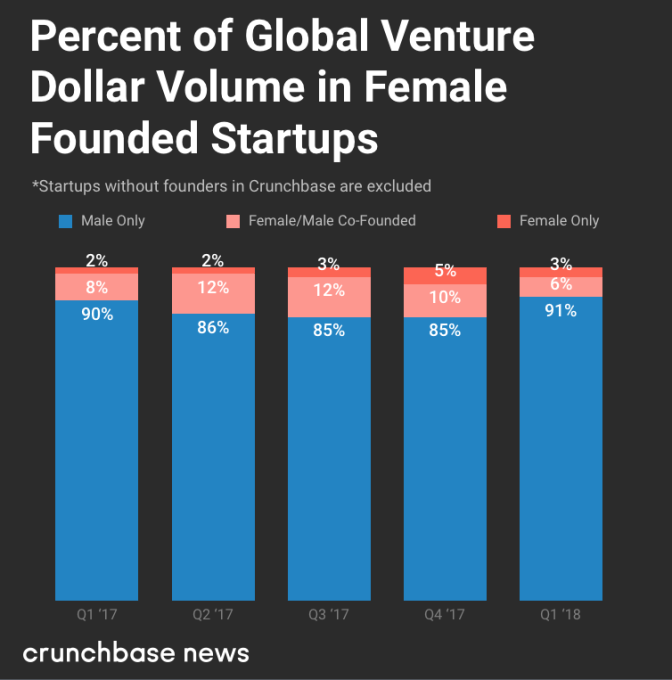
Overall, the money invested into companies with at least one female founder represents just nine percent of venture dollars invested in Q1 2018. That is one percentage point below Q1 2017’s 10 percent result. The second, third and fourth quarters of 2017 all presented higher percentages, as well: 14, 15 and 15 percent of venture dollars invested in those quarters, respectively.

When we narrow the criteria, however, the figures fall. In the Q1 2018, three percent of venture dollars were invested in solo female founders.

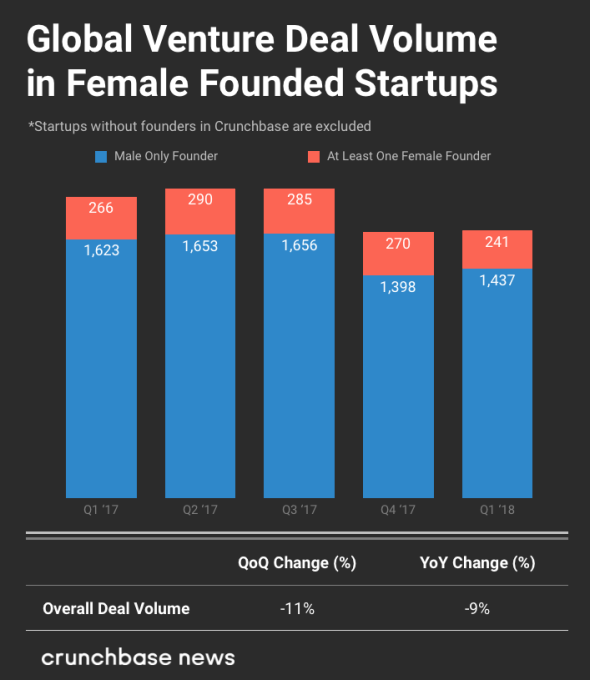
From a deal volume perspective, Q1 2018 saw 14 percent of venture deals include at least one female founder. That result mirrored the year-ago, Q1 2017 figure. However, in line with what we saw when looking at 2017’s dollar volume breakdown between teams with and without women, the interim quarters showed a higher deal count at 15 and 16 percent of all venture deals.

Deals of note

While the deal and dollar volume progress will disappoint many, inside the data are a host of interesting deals that we’d like to highlight. However, in the interest of space, we’ve selected three to share.

Here are the notable venture deals made in Q1 2018 with female founders that caught our eye:

  • Glossier: A New York-based direct to consumer beauty company founded by Emily Weiss. Glossier raised a $52 million Series C round. Index Venture and Institutional Venture Partners led the Series C round.
  • DataVisor: A Silicon Valley-based fraud prevention company led by two female founders, Yinglian Xie and Fang Yu. DataVisor raised a Series C round of $40 million. Sequoia Capital China led the round with previous investors NEA and GSR Ventures participating.
  • Zum: A provider of scheduled on-demand rides for parents of children for highly vetted drivers, founded by Ritu Narayan. Zum raised a $19 million Series B round from Spark Capital with previous investors Sequoia Capital and AngelPad participating.

Next, we’ll turn to who is cutting the checks. Or, more precisely, which firms are investing in companies with female founders.

Leading venture investors in female founders

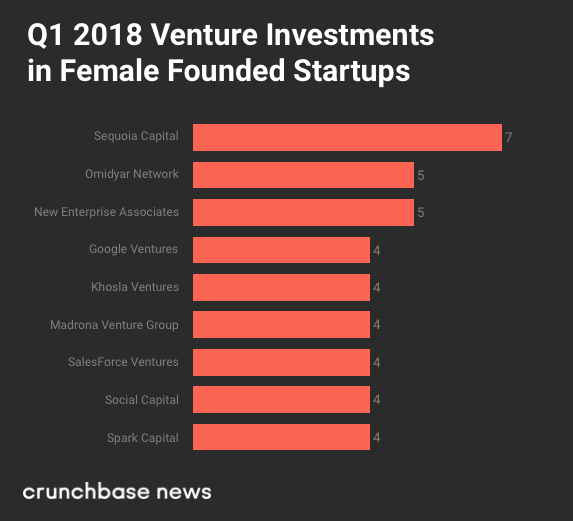
Investors that represented the highest deal count in startups with at least one female founder include Sequoia Capital with seven investments and Omidyar Network with New Enterprise Associates at five each for Q1 2018.

But, of course, investors have different focuses, especially when it comes to startup maturity. So, to that end, we’ll break down investment into companies with female founders of one particular stage.

Seed investments in female founders

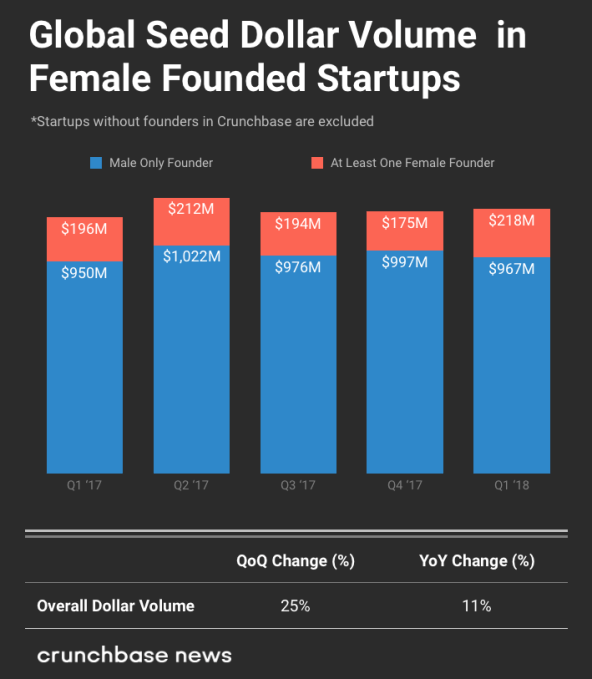
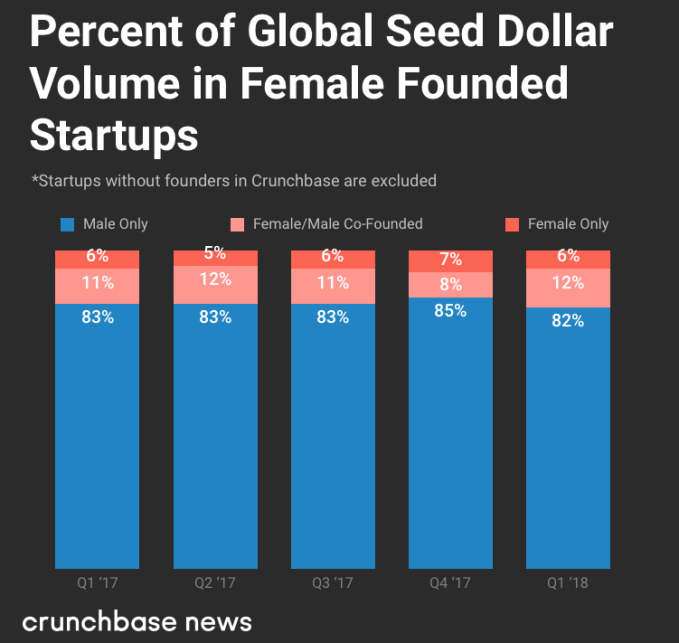
Seed-funded companies with at least one female founder raised $218 million in Q1 2018. This represented 18 percent of all seed dollar volume for the quarter, up from 15 percent in Q4 2017 and 17 percent in Q1 2017.

Overall, seed is a leading indicator for venture, and it has been growing year over year in absolute dollar terms and by percent since 2009 when we first started measuring these trends. That means that if the percentage of deals and dollars at the seed level that women are raising is going up, we may be able to expect more women-founded early, middle and late-stage companies to raise venture capital in time.

Here’s a look at the dollar volume of seed capital invested into companies with and without female founders:

Next here’s the same data in relative percentage terms.

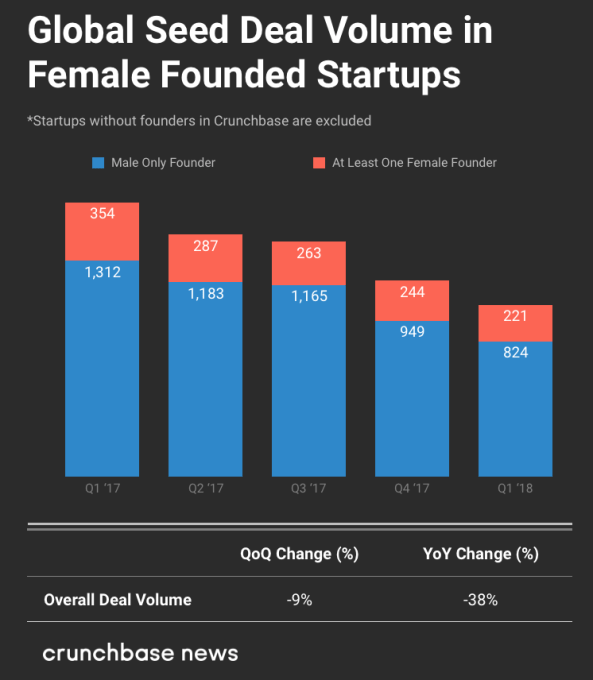
Returning to the big picture, seed deal counts are down slightly quarter over quarter. As more than 59 percent of seed deal volume is reported after the end of a specific quarter, the count of seed deals will increase from what is listed below:

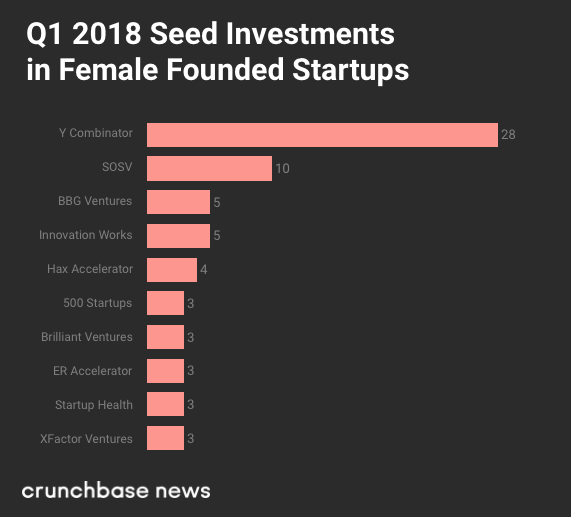
Again, we now want to know who was closing these deals with female founders.

Leading seed investors

Leading seed investors in companies with at least one female founder include Y Combinator with 28, SOSV with 10 and BBG Ventures and Innovation Works at five investments each.

Investing in diverse founders

Kapor CapitalBackstage CapitalBBG VenturesBroadway AngelsPipeline Angels and more have been leading the charge to invest in diverse founders. With the increase in the number of female founders in the last five years, pressure has been growing on the broader venture capital community. With 74 percent of the top 100 firms with no female investing partners, bringing women and minorities both into their ranks and into their investment portfolios is a goal.

All Raise sets new goals for investing in diverse founders

AllRaise.org, which launched this past week, led by prominent female venture investors, seeks to impact these numbers. The organization has set the goal within the U.S. for the percent of female investing partners to double from 9 percent to 18 percent within 10 years or by 2028.

Why 10 years? For the venture industry that’s the typical life term of a single fund. Venture is a cottage industry with partners typically committing to stay for the lifetime of one or more funds. Therefore, turnover at the partner level tends to be much slower than other industries. With funds raising ever-larger amounts, and more often, expanding teams provides an opportunity to bring on diverse candidates. According to All Raise, the fastest growth for female partners is not with existing firms, but with new funds.

In the next five years, All Raise would like to see venture investments in female-founded companies move up from 15 percent to 25 percent. The organization is leading efforts to impact these numbers directly with Female Founder Office Hours supporting women who are seeking funding, to having tech founders and CEOs commit to increasing diversity in their team, board and investors.

Crunchbase is partnering with All Raise to keep abreast of these numbers within the U.S. market. For venture investments in female founders, we have a ways to go to get to 25 percent within the next five years. Reviewing the data over the last 10 years, 2015 is the first year that companies with at least one female founder have broken through the threshold of 10 percent of venture dollars. 2017 represents the best full year to date, at 14 percent of venture dollars.

The U.S. market mirrors this percent. We would need to see an average of two percentage growth points each year to reach this goal. With the number of female-founded companies growing slowly each year, these numbers are a stretch; however, it may still be attainable.


from TechCrunch https://ift.tt/2JT4qF7

Virtual Instagram celebrity ‘Lil Miquela’ has had her account hacked

The Instagram account for the virtual celebrity known as Lil Miquela has been hacked.

The multi-racial fashionista and advocate for multiculturalism, whose account is followed by nearly 1 million people, has had “her” account taken over by another animated Instagram account holder named “Bermuda.”

Welcome to the spring of 2018.

The hack of the @Lilmiquela account started earlier today, but the Bermuda avatar has long considered Miquela her digital nemesis and has taken steps to hack other of Miquela’s social accounts — like Spotify — before.

Because this is the twenty-first century — and given the polarization of the current political climate — it’s not surprising that the very real culture wars between proponents of pluralism and the Make America Great Again movement would take their fight to feuding avatars.

In posts on the Lil Maquela account, Bermuda proudly flaunts her artificial identity… and a decidedly pro-Trump message.

Unlike Miquela, whose account plays with the notion of a physical presence for a virtual avatar, Bermuda is very clearly a simulation. And one with political views that are diametrically opposed to those espoused by Miquela (whose promotion of openness and racial equality has been a feature that’s endeared the account to followers and fashion and culture magazines alike).

Miquela Sousa, a Brazilian-American from Downey, Calif., launched her Instagram account in 2016. Since the account’s appearance, Miquela has been a subject of speculation in the press and online.

Appearing on magazine covers, and consenting to do interviews with reporters, Miquela has been exploring notions of celebrity, influence and culture since her debut on Facebook’s new most popular social media site.

A person familiar with the Lil Miquela account said that Instagram was working on regaining control.


from TechCrunch https://ift.tt/2J4K9v2

Electric scooter permits will be required in San Francisco

The San Francisco Board of Supervisors unanimously voted today to approve the ordinance that looks to regulate electric scooters in San Francisco. The ordinance seeks to establish regulation and a permitting process that would enable the San Francisco Municipal Transportation Agency or Department of Public Works to take action against scooters from companies that don’t have an official permit from the city.

“Part of the brouhaha has been really the function of the fact, which was admitted yesterday, was that some of these companies have been a little bit fast and loose with the truth,” Supervisor Aaron Peksin, a sponsor of the ordinance, said today at the Board of Supervisors meeting.*

Peskin is referencing the fact that Lime, Spin and Bird deployed their respective scooters without permission from the city. The permitting scheme the city has in mind, Peskin said, is very similar to the one San Francisco has in place around stationless bike-sharing.

“This is a basic permitting scheme to allow the professional staff at SFMTA to permit these with sensible, regulatory frameworks and to be able to confiscate unpermitted vehicles or devices,” Peskin said.

He added that these electric scooters can absolutely serve some benefits to people in San Francisco, but that it does not mean the city should have to sacrifice its sidewalk space. The next step is for the BOS to continue working with the SFMTA to develop this regulation. At a hearing yesterday, the SFMTA said it hopes to open up the permitting process by May 1.

Earlier in the meeting today, the BOS adopted a resolution to develop a working group to inform future legislation around emerging technologies. One of the resolution’s sponsors, Supervisor Norman Yee, noted how he’s heard from seniors and people in wheelchairs who are “being imperiled and inconvenienced because they are having to navigate around scooters and bikes.”

He later added, the purpose of the working group would be to ensure the city is mindful of both the intended and unintended consequences of emerging technologies.

Yesterday, SF City Attorney Dennis Herrera sent cease-and-desist letters to Lime, Bird and Spin, but that doesn’t seem to be making any difference to Lime, Bird and Spin. All three of their respective scooters were found on the streets of San Francisco this morning.

“As it says in the letter, the City Attorney has laid out some recommendations for operation that he will like to see implemented by April 30; he has not requested an immediate stoppage of service,” a Bird spokesperson told TechCrunch. “We are taking his concerns very seriously and reviewing his recommendations for improving Bird in San Francisco.”

Lime says it’s taking the City Attorney seriously, as well as the vote by the BOS today.

“In response, we are updating our current community outreach plan to address the City’s concerns about pedestrian safety, parking compliance, and rider education,” a Lime spokesperson told TechCrunch. “We plan to roll out new initiatives, along with our complete response to the City Attorney by the end of next week.”

Lime says it will also provide helmets to users, which will we able for pickup starting April 22. Similar to Bird, Lime will also start requiring people to submit a photo of their properly parked scooter at the end of the ride. Additionally, Lime says it will more clearly state that riding on or blocking sidewalks is illegal.

I’ve reached out to Spin about its operations in San Francisco. I’ll update this story if I hear back.

An earlier version of this story misattributed Supervisor Aaron Peskin’s quotes to another supervisor.


from TechCrunch https://ift.tt/2vng9bJ

Leaked Tesla email says Model 3 will go to 24/7 production

Tesla is about to ramp up production of the Model 3 sedan according to an email obtained by Jalopnik. The company shut down the sedan’s production line this week, but this email says the line will soon be running and a third shift will be added, allowing the sedan to be built around the clock. Tesla is aiming to produce 6,000 Model 3 sedans per week by June.

The email, reportedly penned by Elon Musk, details a wide-range of topics, including Model 3 production, financial expenditures, manufacturing tolerances, Tesla’s lack of financial profit and how meetings can kill a company.

According to this note, the Model 3 line will be down for three to five days “to do a comprehensive set of upgrades.” It states that this will allow Tesla to ramp up production to 3,000 to 4,000 Model 3 sedans by next month. Then, the company plans to implement another set of upgrades to allow for 6,000 by the end of June. Last week, according to this email, Tesla completed its third consecutive week of making more than 2,000 Model 3s.

It’s a tall order to expect production to triple in two months.

To help meet this expectation, Tesla is adding another shift to general assembly, body and paint at its Fremont facility. Between Fremont and its Gigafactory, Tesla is looking to 400 additional employees to help meet the production schedule.

This news about increasing production comes amid questions about safety and work conditions in Tesla’s facility. Though Tesla fiercely pushes back against the news, the questions will likely continue as workers fight to meet Musk’s lofty production expectation.

Musk is apparently looking to rein in expenditures, too, noting that anything costing more than a million dollars requires his direct approval. Maybe he will accept that couch fans raised money for.

Jalopnik published the email in its entirety, and the bit at the end about meetings is worth reading. This is just part of it: “Excessive meetings are the blight of big companies and almost always get worse over time. Please get of all large meetings, unless you’re certain they are providing value to the whole audience, in which case keep them very short.”

Tesla has yet to respond with a comment.


from TechCrunch https://ift.tt/2qDOZsd

IRS payment site crashes on tax day

Twitter’s brief morning outage was stressful enough — but those who’ve waited until the last possible moment to pay their tax bills have a much more distressing site crash to worry about: The Internal Revenue Service’s Direct pay site is down the day taxes are due.

It’s been experiencing issues for a number of hours already, and is still unreachable as of this writing. Those who visit the page will be met with a friendly red banner bearing a large exclamation mark and the words “Alert: This service is currently unavailable. We apologize for any inconvenience.”

I mean, you didn’t really want to pay your taxes anyway, right?

The site specifically handles pay transfers from checking or savings accounts. There does appear to be a workaround, if you pay with a credit or debit card — though you’ll also be charged a transaction fee. Still, it might be worth the $2 to $4 for the peace of mind.

The IRS says it believes this is all the result of a glitch, rather than something more nefarious like hacking. Perhaps it was even the last-minute strain on the system, though failing on tax days is like giving up a grand slam during game seven of the World Series when you’re an electronic transfer site.

“We are working to resolve the issue and taxpayers should continue to file as they normally would,” acting IRS commissioner David Kautter said in an address today, relayed by The Washington Post. He added that, due to the crash, late payments will “not be penalized because of a technical problem the IRS is having.”


from TechCrunch https://ift.tt/2JSk6IM

Buick unveils an all-electric SUV concept and it’s exactly what GM needs

General Motors is spinning up its electrification plans and today announced the stunning, poorly named Buick Enspire concept at Auto China 2018. As a concepts go, this one looks great and rather feasible.

GM says it’s powered by Buick’s eMotion powertrain that can produce a maximum output of 410 kW (roughly 550 hp). This should make it good for a 4-second sprint to 60 mph. Range is clocked at 370 miles and the battery can be recharged to 80 percent within 40 minutes. It supports both fast and wireless charging.

The 2018 Buick Enspire all-electric concept SUV

Inside is an augmented reality windshield, OLED display and wood center console. And because this is just a concept and nothing is real, the Enspire features a 5G connection.

GM made a big promise in 2017 to release 20 electric vehicles within the next five years. The company is going all-in on electric vehicles, and something like this Buick would fit nicely in the world of crossovers and mild SUVs. I think it looks better than the Tesla Model X, but of course, the Model X is real and this is just a concept.

The Envision was announced in China, where the Buick nameplate is well-loved. It will be interesting to see if GM releases this sharp SUV under a different brand though. To me, throw a new grill on it, drop the dumb name and that SUV could be the future of Chevy.

Pricing and availability were not announced.


from TechCrunch https://ift.tt/2qEkAKq

Ripple’s Brad Garlinghouse and Michael Arrington to talk cryptocurrency at Disrupt SF

Ripple CEO Brad Garlinghouse and Arrington XRP Capital founder (and TechCrunch founder) Michael Arrington will be joining us at TechCrunch Disrupt SF in September to talk money.

Garlinghouse has had a long and storied career in the tech industry, serving as a senior vice president at Yahoo!, president of Consumer Applications at AOL and CEO of the file collaboration service Hightail. But in 2016, Garlinghouse was promoted from COO to CEO at payment services company Ripple.

Ripple’s goal is to try to make it as easy as possible to transfer money between two stores of value. Right now, that process is incredibly tedious, with no unifying structure to send money overseas or to underbanked communities. The notion of a unifying ledger is not a new one, but it’s one that’s transformed Ripple into a full-fledged company.

But Ripple also created the world’s third-largest digital token, XRP. The token has a current total market cap around $30 billion, and the company is working to expand the use cases for XRP, which has primarily been marketed as a tool for banks but has only attracted cross-border payment services.

As cryptocurrencies continue to evolve and gain mainstream attention, questions continue to mount around how these tokens will revolutionize the economy and gain utility.

TechCrunch founder and former Editor-In-Chief Michael Arrington will join Garlinghouse onstage to discuss the evolution of cryptocurrencies. Arrington left TechCrunch in 2011 and went on to start CrunchFund, which has invested in big-name startups such as Uber, Airbnb and Yammer.

In 2016, Arrington reduced his role at CrunchFund and has since started Arrington XRP Capital, a $100 million digital asset management firm in blockchain-based capital markets. Ripple is one of the first portfolio companies for Arrington XRP Capital.

This comes at a time when the SEC is doing everything it can to learn more about cryptocurrencies, sending out subpoenas to crypto funds far and wide, including Arrington XRP Capital.

This conversation is sure to be an interesting one, and one you won’t want to miss. Tickets to Disrupt SF (September 5 to September 7) are available now.


from TechCrunch https://ift.tt/2qG4z5T

Supreme Court dismisses warrant case against Microsoft after CLOUD Act renders it moot

A long-running legal battle between the U.S. government and Microsoft has been dismissed by the Supreme Court (PDF) after the crux of the conflict was mooted by recent legislation. The company will now be forced to provide data stored on servers in Ireland that it had previously said should be obtained through that country’s authorities.

The case dates to 2013 and has become a sort of landmark on the frontier between global politics and tech. American law enforcement sought data on a user of Microsoft services in relation to a drug trafficking case; Microsoft said that the data in question was located exclusively in a data center in Ireland, and as such they must work out access with Irish authorities.

The U.S., of course, took issue with that since Microsoft is an American company, and the argument has gone back and forth for years. So far Microsoft has maintained a slight edge, to the delight of privacy advocates everywhere, who dislike the idea that global tech services should be so vulnerable to a single country’s whims.

It was on its way to a judgment by the Supreme Court, but legislators decided to intervene. The CLOUD Act, tacked onto thousands of pages of mixed bills and budgets pushed forward in a “too big to veto” omnibus spending package, changes the law so Microsoft’s arguments essentially cease to exist.

Under the CLOUD Act, companies must provide information properly requested by law enforcement “regardless of whether such communication, record, or other information is located within or outside of the United States.”

Microsoft itself supported this bill, along with other tech companies like Google and Apple, so this outcome won’t be a surprise. And although the CLOUD Act has its shortcomings, privacy and human rights advocates have offered cautious praise for the way it streamlines the global data exchanges that are so common now in cross-border investigations of major crimes.

The company issued the following statement on the decision:

We welcome the Supreme Court’s ruling ending our case in light of the CLOUD Act being signed into to law. Our goal has always been a new law and international agreements with strong privacy protections that govern how law enforcement gathers digital evidence across borders. As the governments of the UK and Australia have recognized, the CLOUD Act encourages these types of agreements, and we urge the US government to move quickly to negotiate them.

It would be premature and simplistic to say that this is a good or bad thing in the world of privacy — it depends a lot on who you trust and the shifting sands of courts and regulations. Its effects will likely be mixed and will provoke new legal battles while settling others, like this one. Lawmakers, tech companies and advocacy organizations will all be watching closely.


from TechCrunch https://ift.tt/2qFK89o

Enterprise AI will make the leap — who will reap the benefits?

This year, artificial intelligence will further elevate the enterprise by transforming the way we work, securing digital assets, increasing collaboration and ushering in a new era of AI-powered innovation. Enterprise AI is rapidly moving beyond hype and into reality, and is primed to become one of the most consequential technological segments. Although startups have already realized AI’s power in redefining industries, enterprise executives are still in the process of understanding how it will transform their business and reshape their teams across all departments.

Throughout the past year, early adopting businesses of all sizes and industries began to reap benefits. AI applications with AI-powered capabilities introduced opportunities to change the way the enterprise engaged customers, segmented markets, assessed sales leads and engaged influencers. Enterprises are on the edge of taking this a step further because of the amount of knowledge and tools leveraging the potential of AI within their entire organization.

“New breakthroughs in AI, enabled by new hardware architectures, will create new intelligent business models for enterprises,” says Nigel Toon, co-founder and CEO at U.K.-based Graphcore. “Companies that can build an initial knowledge model and launch an initial intelligent service or product, then use this first product to capture new data and improve the knowledge model on a continuing basis, will quickly create clear class-leading products and services that competitors will struggle to keep up with.”

The category is evolving, and large companies are finding distinct ways to innovate. They can uniquely tap into decades of industry experience to develop horizontal AI, built for specific industries like healthcare, financial services, automotive, retail and more. These implementations, though, require deep industry expertise and industry-specific design, training, monitoring, security and implementation to meet the high-stakes IT requirements of global organizations.

“In 2018, AI is entering the enterprise. I believe we will see many enterprises adopt AI technology, but the (few) leaders will be those that can align AI with their strategic business goals,” says Ronny Fehling, associate director of Gamma Artificial Intelligence at BCG.

2018: AI will start separating the winners from the losers

Early industry successes (and failures) proved AI’s inevitability, but also the reality that wide-scale adoption would come through incremental progress only. This year, we’ll see AI move from influencing product or business functions to an organization-wide AI strategy. Expect the winners to move fast and remain nimble to keep implementing off-the-shelf and proprietary AI.

The companies that win the AI talent war will gain exponential advantages, given the category’s rapid growth.

Hans-Christian Boos, CEO and founder of Germany-based Arago, adds: “2018 will be a make or break year for enterprise and the established economy in general. I believe AI is the only viable path for innovation, new business models and digital disruption in companies from the industrial era. General AI can enable these enterprises to finally make use of the only advantage they have in the battle against new business models and giants from the Silicon Valley, or rather giants from the new age of knowledge based business models.”

The AI talent challenge

A boon in enterprise AI will also mean a further shortage of talent. Industries like telecommunications, financial services and manufacturing will feel the talent squeeze the most. The companies that win the AI talent war will gain exponential advantages, given the category’s rapid growth.

Hence, enterprises will try to attract talent by offering a powerful vision, a track record of product success, a bench of early client implementations and the potential to impact the masses. It’s about developing high-functioning and reliable solutions that become a new foundation for clients.

Developers and data scientists, however, are only the beginning. Winning enterprises must adopt their organizational structures that attract a new generation of product managers, sales, marketing, communications and other delivery teams that understand AI. This requires an informed, passionate and forward-thinking group of professionals that will help customers understand the future of work and customer engagement powered by AI.

AI adoption and employee training

Digital transformation, powered in large part by new AI capabilities, requires enterprises to understand how to extract data and utilize data-driven intelligence. Data is one of the greatest assets and essentials in maximizing the value in an AI application, yet data is often underutilized and misunderstood. Executives must establish teams and hold individuals across departments accountable for the successful and ongoing implementation of digital tools that extract full value from available internal and external data.

This transformation into an AI-native organization requires it to hire, train and re-skill all levels of employees, and provide the resources for individuals to adopt AI-powered disciplines that enhance their performance. Most workforce, from top to bottom, should be encouraged to rethink and evolve their role by incorporating new digital tools, often enabled by AI itself.

Expect AI and other digital technologies to become more prevalent in all business disciplines, not only at the application layer, as Vishal Chatrath, co-founder and CEO of U.K.-based Prowler.io emphasises. “Decision-making in enterprise is dominated by expert-systems that are born obsolete. The AI tools available till now that rely on deep-neural nets which are great for classification problems (identifying cats, dogs, words etc.) are not really fit for purpose for decision-making in large, complex and dynamic environments, because they are very data inefficient (needs millions of data points) and effectively act like black-boxes. 2018 will see Enterprise AI move beyond classification to decision-making.”

What’s next

However, the spotlight will shine on data governance as businesses adjust entire departments and workflows around data. In turn, data management and integrity will be an essential component of success as consumers and enterprises gain greater awareness about how companies use customers’ data. This opens a large field of opportunities, but also will require transparency in how companies are using, sharing and building applications on top of customer data to ensure trust.

“Every single industry will be enhanced with AI in the coming years. In the last years there was a lot of foundation work on gathering standardized data and now we can start to use some of the advanced AI techniques to bring huge efficiency and quality gains to enterprise companies,” says Rasmus Rothe, co-founder and CTO of Germany-based research lab and venture builder Merantix. “Enterprises should therefore thoroughly analyze their business units to understand how AI can help them to improve. Partnering with external AI experts instead of trying to build everything yourself is often more capital efficient and also leads to better results.”

The shift toward AI-native enterprises is in a defining phase. The pie of the AI-enabled market will continue to grow and everyone has an opportunity to take a slice. Enterprises need to quickly leverage their assets and extract the value of their data as AI algorithms themselves will become the most valuable part when data has become a commodity. The question is, who will move first, and who will have the biggest appetite.


from TechCrunch https://ift.tt/2Hquedp

Amazon launches a ‘lite’ Android web browser app in India

Amazon has quietly launched an Android web browser app for emerging markets, where access to mobile data and high-speed connectivity is more limited. The browser has the rather generic name of: “Internet: fast, lite and private” on Google Play, and promises to be “lighter than the competition.”

The app first appeared on the Play Store in March, and has fewer than 1,000 downloads, according to data from app store intelligence firm Sensor Tower.

It’s only available to users in India for the time being, and is supported on devices running Android 5.0 or higher.

Like most “lite” apps, the new browser is a small download — it’s less than 2 MB in size. That’s much smaller than other browsers, including Chrome (21MB), Edge (54.5MB), Firefox (19.9MB) and Opera (14.7MB), according to an analysis by appFigures.

The browser’s Google Play description also notes that it’s “private,” as it doesn’t ask for extra permissions or collect private data like other browsers do. This seems to indicate that it’s meant to be something of a competitor to other private mobile browsers, like Firefox, which blocks website trackers.

The browser additionally supports Private tabs, so you can browse without saving visits to your history, plus other features like tab previews, an automatic full-screen mode and integrated news reader of sorts.

In fact, the news reading experience is another telling indication that the browser is only meant for Indian users. The app’s description notes the browser homepage is designed to keep you up-to-date with news, cricket and entertainment from top sources. Yep, cricket — the most popular sport in India.

And finally, the “feedback” email on Google Play points to Amazon India, which indicates it was built by that team.

In addition to the new browser, Amazon also offers a Kindle Lite app in India.

The company is not alone in building lightweight mobile apps for emerging markets.

Facebook also offers “lite” versions of its apps, like Facebook Lite and Messenger Lite, to reach users with limited connectivity and access to data. Google has also rolled out a suite of lightweight mobile apps under the “Go” branding. Some of these, like Gmail Go, only come pre-installed on select devices. Others, meanwhile, are available through Google Play for anyone to download, like YouTube Go, Files Go, Google Go, Google Maps and Google Assistant Go.

[gallery ids="1623840,1623839,1623842,1623841"]

It is interesting, however, that Amazon didn’t adopt a similar strategy by offering a “lite” version of its existing Silk browser, but has instead built something new.

And if its goal is to offer an alternative to Silk on the Fire tablets it sells in India, it’s odd that the browser isn’t yet available in the Amazon Appstore in India.

Amazon has not yet returned a request for comment about the new app.


from TechCrunch https://ift.tt/2HIIN9Q

Tuesday, April 17, 2018

Nike’s Vaporfly Elite FlyPrint leans hard into computational design

Computational design is the hottest phrase in manufacturing and 3D printing at the moment. It’s changing the way people make all kinds of goods, and Nike used it to design and manufacture its new Vaporfly Elite FlyPrint shoe, which it’s announcing today.

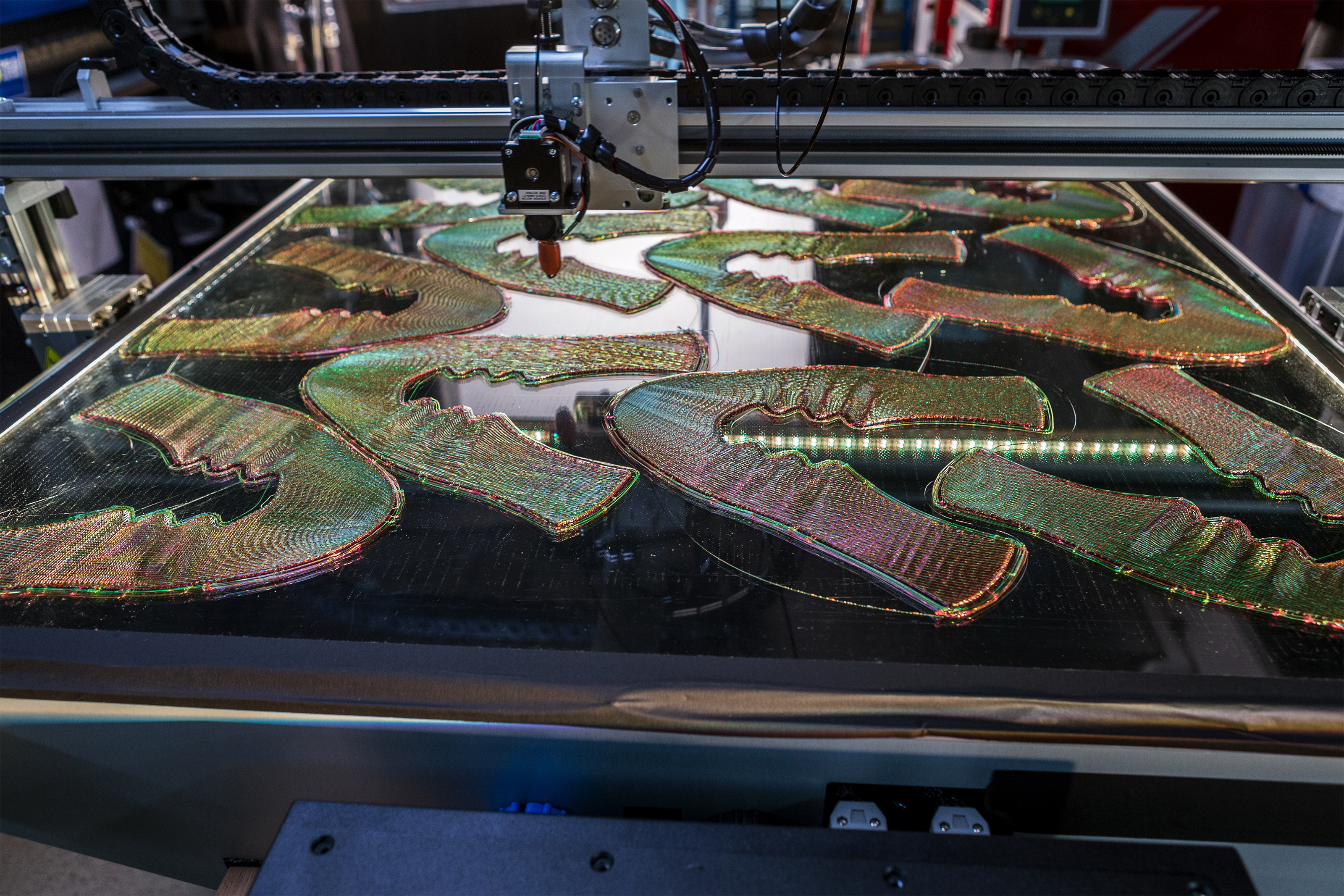
The shoe is a specialized edition of its Zoom Vaporfly Elite 4%, which was used by elite runner Eliud Kipchoge during Nike’s Breaking2 event, which resulted in the fastest marathon ever run. The special sauce in this edition is the FlyPrint upper, which is printed on the fly by a specially customized 3D printer out of a proprietary Nike polymer.

I spoke with Nike’s Brett Holts, product line manager for running footwear and Roger Chen, a senior director for Nike’s NXT Digital Innovation department, about the process and the shoe.

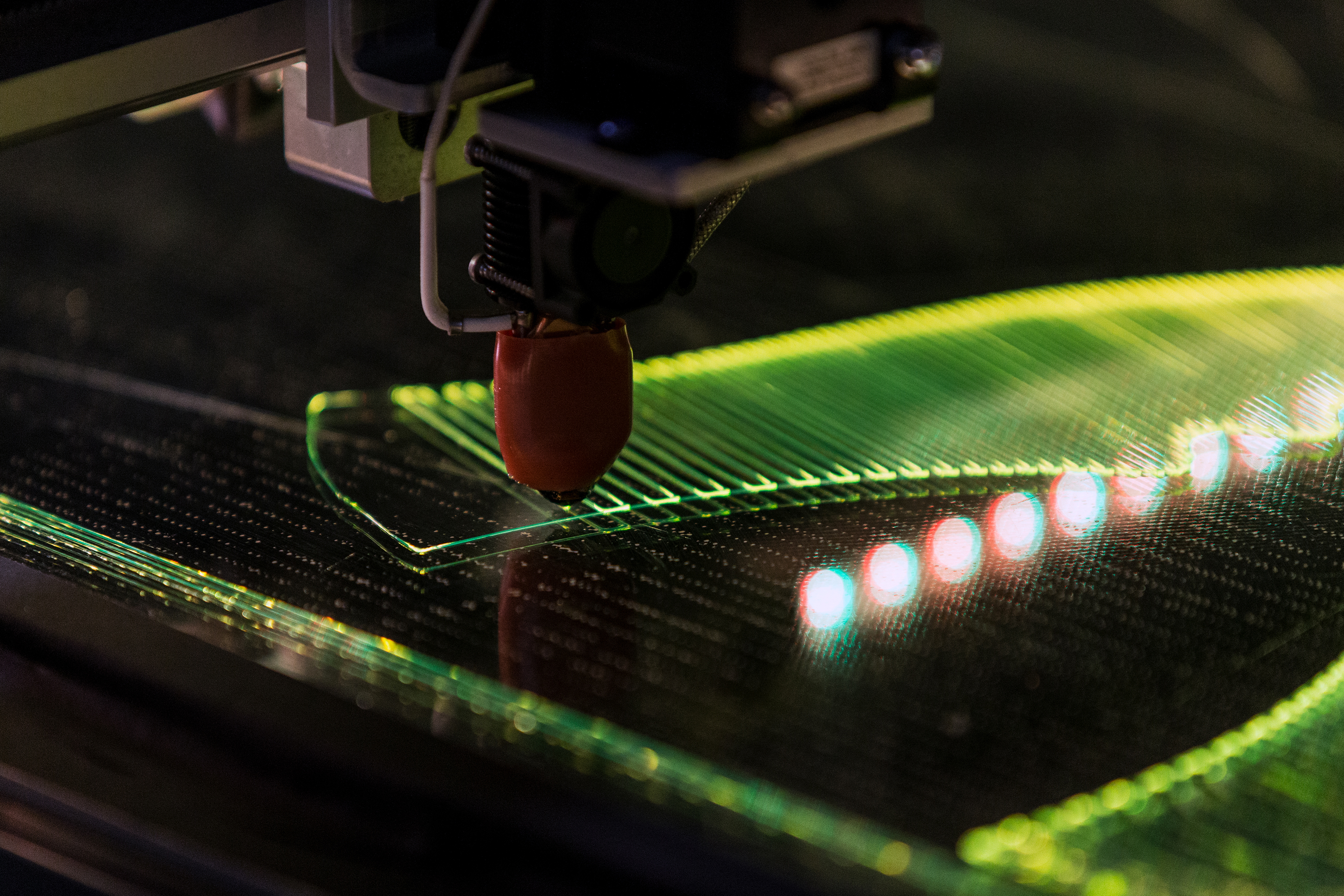
The material is printed out in a pattern specifically designed for a given athlete’s needs and attached to the much hyped Zoom X foam midsole from the 4% model. The process, which Nike is calling FlyPrint, has some similarities to Nike’s other famous ‘fly’ process, FlyKnit, hence the name. The printing process, says Chen, is a lot like painting the material.

The uppers I saw pre-lasting look a lot like a regular butterfly upper, with the same kind of flexibility you’re used to seeing from fabric or other polymer-based upper materials. This is not a hard-shell 3D-printed material, it’s a fabric of sorts. This is reinforced by the fact that several components of the shoe are still made of FlyKnit including the tongue and collar. Those parts are so similar in chemical composition that there is no glue needed to attach them. Instead, the FlyPrint material is bonded seamlessly with the FlyKnit, making for a one-piece design that is stronger and lighter.

The process of computer aided design in consumer products has a long history — but computational design is an evolution of this concept and has begun to gain steam lately with production-ready 3D-printing processes like Carbon’s M-series digital light synthesis printers and Desktop Metal’s Production System. The guiding force behind computational design is that you feed parameters and physical properties into a model — basically limitations and desired outcomes — and get designs that would either be impossible or incredibly time consuming for humans to produce.

In the case of the new FlyPrint upper, the constraints are the properties of the material and the forces that Kipchoge’s feet were exerting on that material. With that data, along with the chemical composition of the polymer, a computational model allowed Nike to tweak the design for support, flexibility, reinforcement or relaxation on a much more granular level than they could ever accomplish with FlyKnit.

If, for instance, Kipchoge felt that he needed more support through the arch area, the team could tweak that metric in that region, resulting in a more compact pattern of diamond-shaped lattice. In the FlyKnit world (and the world of most knit running shoes) this is done by creating various panels that reflect the properties you want from that portion of the shoe and glueing or stitching them together, adding weight and reducing strength.

Now, Nike can print a fully customized upper in one go, blending it seamlessly with FlyKnit where it makes sense for comfort.

The result of all of this is that the shoe is incredibly light. A 12 gram, or 6% reduction in weight to start. On top of that, one of Kipchoge’s big issues with the Vaporfly Elites in Berlin was water retention in the rain. The shoes started out light but water soaked into the FlyKnit and couldn’t fully make its way out. The FlyPrint upper is nearly translucent it’s so porous, which solves the drainage issue.

Chen says that Kipchoge said that it ‘felt like he was flying’ because he could feel the wind on his feet.

Another huge advantage to FlyPrint, points out Holts, is speed. Nike was able to design and construct every iteration of the shoe through to the final model in just 4 months. As a frame of reference, it typically takes 9 months to a year to get a shoe off the ground.

“We would never have been able to do that [with FlyKnit],” says Holts, “we were addressing the needs of our athlete within 24 hours.”

This day-long cycle — taking into account the Kenyan time differential — of trading feedback with Kipchoge and turning around his requested updates to fit or function was uniquely enabled by using the FlyPrint process.

Additionally, the modeling component of the process allows Nike to scale the shoe through various sizes while maintaining the appropriate ratios of material to negative space for each section.

Nike is using an established 3D printing process called fused deposition modeling, basically painting shapes onto a surface with production-ready TPU materials, but Chen says that the proprietary components of the process lie in how the printers are being driven to lay down the FlyPrint. Neither will say what printers Nike is using but note the company’s history in ‘hacking’ manufacturing tools to get the job done. As an industry note, Stratasys is one of the more established players in FDM printing.

Computational design and production ready 3D printing are changing footwear as we speak. Adidas and Carbon are focusing on the midsole in fashion and basketball, Nike is reinventing the upper for elite runners. But the real gem here might not be the speed or customization — both important advancements.

Instead, it could be the way that the design process is compressed down to mate directly with the manufacturing process. This has the potential to change not just footwear, but every kind of product made. Instead of the lengthy and costly process of injection molding or milling, product designers are, for the first time ever, able to start taking direct ownership of the production process, realizing impossible designs and goals with the use of a powerful feedback loop that includes designer, materials and process in one flow of data.

The Vaporfly Elite FlyPrint is a product for elite runners only, and a small amount of them will be available at an event in London soon, as well as on the feet of Kipchoge and other Nike runners. But there is an epochal shift in the way shoes (and other products) are made coming, and this is one of the harbingers of that shift. Pay attention.


from TechCrunch https://ift.tt/2Hs6CFb

Taiwanese startup Kdan Mobile raises $5M Series A for its cloud-based content creation tools

Kdan Mobile founder and CEO Kenny Su

Kdan Mobile, a Taiwanese startup that makes cloud-based software for content creators, announced a $5 million Series A today, raised from investors including W.I. Harper Group, Darwin Venture Management and Accord Ventures. Founded in 2009, the Tainan City startup says its products have been downloaded more 120 million times, with about 40% of its customers located in the United States.

Its Series A takes Kdan Mobile’s total funding so far to $6.5 million. The capital will be used for product development, including blockchain-based encryption for documents and real-time collaboration features, to appeal to enterprise and education users. The company also plans to spend more on user acquisition in the U.S. and China, two of its growth markets.

Kdan Mobile’s products include Creativity 365, a software suite with a mobile animation creator and video editor, and Document 365, launched last year to attract enterprise users. The company also recently began offering new subscription plans for businesses and educational organizations and claims that its cloud platform, called Kdan Cloud, now counts over 3.5 million members.

Founder and chief executive officer Kenny Su says Kdan Mobile is seeking new partners that will allow it to establish a bigger presence in markets like Japan. One of its Series A investors, Accord Ventures, is based in Tokyo, and Kdan Mobile may start marketing to the country’s animation industry, Su tells TechCrunch. The company already has partnerships with Taiwanese mobile services provider GMobi, Jot Stylus maker Adonit and Ningbo, China-based design sharing platform LKKER.

Su says one of the ways Kdan’s products differentiate from cloud-based software by Google, Microsoft, Adobe and other major competitors is its focus on artists, designers and other creative professionals. Kdan’s products were also created to allow users to start projects on mobile devices before moving onto desktop apps. As many users of Google Docs, Office 365 or Adobe Creative Cloud have discovered, accessing them on mobile devices feels much more awkward than on desktop. Kdan Mobile, however, was founded just as smartphones and tablets usage was becoming widespread, and its products were created specifically for mobile.

“We are trying to fill the gap, helping users create content on mobile and then allowing them to finish it in a desktop environment, not only with our own tools, but also by exporting to other places including Adobe,” says Su.

Part of Kdan Mobile’s Series A financing will also be used to figure out how to the company can increase the use of artificial intelligence in its products. Kdan Mobile already uses machine learning algorithms to improve its software by analyzing what users upload and recommend on its content sharing platform.

In a press statement, W.I. Harper Group managing director Y.K. Chu said “We are stunned by Kdan’s leading development technology and global vision. We are glad to be part of their development plan and expect to grow with them.”


from TechCrunch https://ift.tt/2J4blKb

Minds aims to decentralize the social network

Decentralization is the buzzword du jour. Everything – from our currencies to our databases – are supposed to exist, immutably, in this strange new world. And Bill Ottman wants to add our social media to the mix.

Ottman, an intense young man with a passion to fix the world, is the founder of Minds.com, a New York-based startup that has been receiving waves of new users as zealots and the the not-so-zealous have been leaving other networks. In fact, Zuckerberg’s bad news is music to Ottman’s ears.

Ottman started Minds in 2011 “with the goal of bringing a free, open source and sustainable social network to the world,” he said. He and his CTO, Mark Harding, have worked in various non-profits including Code To Inspire, a group that teaches Afghani women to code. He said his vision is to get us out from under social media’s thumb.

“We started Minds in my basement after being disillusioned by user abuse on Facebook and other big tech services. We saw spying, data mining, algorithm manipulation, and no revenue sharing,” he said. “To us, it’s inevitable that an open source social network becomes dominant, as was the case with Wikipedia and proprietary encyclopedias.”

His efforts have paid off. The team now has over 1 million registered users and over 105,000 monthly active users. They are working on a number of initiatives, including an ICO, and the site makes money through “boosting” – essentially the ability to pay to have a piece of content float higher in the feed.

The company raised $350K in 2013 and then a little over a million dollars in a Reg CF Equity Crowdfunding raise.

Unlike Facebook, Minds is built on almost radical transparency. The code is entirely open source and it includes encrypted messenger services and optional anonymity for users. The goal, ultimately, is to have the data be decentralized and any user should be able to remove his or her data. It’s also non-partisan, a fact that Ottman emphasized.

“We are not pushing a political agenda, but are more concerned with transparency, Internet freedom and giving control back to the user,” he said. “It’s a sad state of affairs when every network that cares about free speech gets lumped in with extremists.”

He was disappointed, for example, when people read that Reddit’s choice to shut down toxic sub-Reddits was a success. It wasn’t, he said. Instead, those users just flocked to other, more permissive sites. However, he doesn’t think those sites have be cesspools of hate.

“We are a community-owned social network dedicated to transparency, privacy and rewarding people for their contributions. We are called Minds because it’s meant to be a representation of the network itself,” he said. “Our mission is Internet freedom with privacy, transparency, free speech within the law and user control. Additionally, we want to provide our users with revenue opportunity and the ability to truly expand their reach and earn rewards for their contributions to the network.”


from TechCrunch https://ift.tt/2JPIKtq

Walmart to launch a more personalized, redesigned website in May

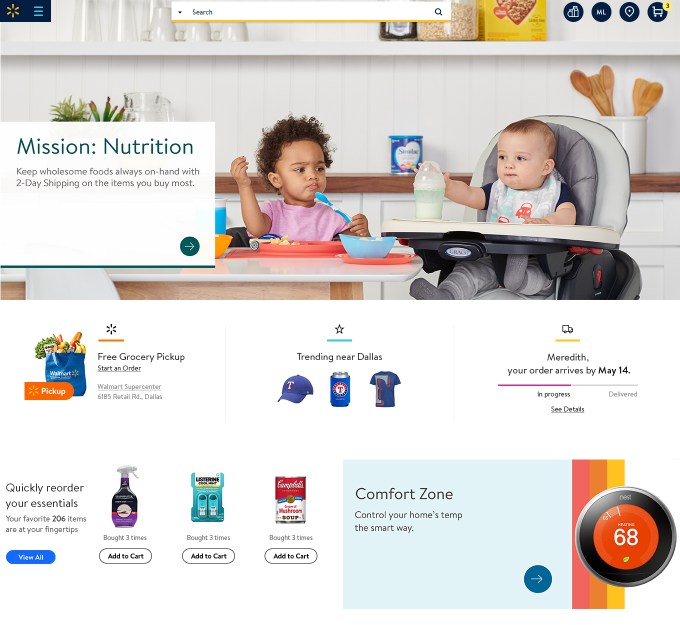
Walmart today is announcing a significant redesign of its website which includes a visual makeover, the introduction of new personalization elements, as well as dedicated sections for specially shopping experiences. The company had already launched a revamped Home section on its site back in February, ahead of this larger redesign, and now plans to soon do the same for its fashion category later this spring. The forthcoming fashion hub will also include a Lord & Taylor online store, as a result of the partnership announced last year.

The Walmart redesign isn’t live today, to be clear. This is just the first look, before it arrives in early May.

The most immediately visible change is to the site’s look-and-feel.

The photography used on the site will include “relatable” photos of real-life moments, says Walmart.

The pages also have a cleaner, more modern design, with pops of color from an expanded color palette, a new set of simply designed icons, rounded “add to cart” buttons, new fonts, and many other changes. Walmart says the goal was to bring more vibrancy and depth to the site.

While consumers may notice the how the site looks different, the larger changes are under the hood.

The new site will be personalized to end users, both on a regional and individual basis.

For starters, the site will showcase what items are trending in shoppers’ area. This is something you see elsewhere on e-commerce sites – like Instacart’s grocery shopping site. But it’s not that interesting to find that spaghetti sauce and La Croix are popular nearby – on a broader e-commerce site, it could be more useful.

During tests, Miami shoppers found that a top-selling item was an Ozark Trail pop-up tent, and in some parts of Illinois, shoppers saw Chicago Cubs tumblrs trending, for example.

“It just really kind of brings that [regional] flavor to life,” says Marc Lore, Walmart’s CEO of U.S. E-commerce. “You want the site to make shopping faster and easier, and when you’re showing those items that customers are trending towards, you’re actually making a faster shopping journey for them, which is ultimately the goal,” he says.

Customers will also be able to see what services are available in their area, like Walmart’s Online Grocery, along with order status features, and Easy Reorder for re-buying their favorite items. (Pictured above).

In addition, the site will recommend products based on what consumers have been browsing and buying. This is an area where Walmart could potentially outclass its rival Amazon, assuming its technology is up to par.

Amazon’s recommendation technology has fallen behind over the years, as the site seems unable to differentiate between gifts for friends and family or other one-time purchases, versus things users regularly search for, desire and buy.

In fact, a humorous tweet about exactly this problem recently went viral, leading to a stream of people responding with their own funny (or unfortunate) examples of the same thing.

Lore claims that Walmart won’t fall prey to this issue.

“The way we attack this problem is not through technology alone,” he says. “We’re able to combine technology and the merchandising elements to create a much more relevant and personalized experience.”

Walmart’s algorithms are meant to understand what categories the individual likes to shop, and then leverages merchants’ understanding of what items are new, trending or seasonal to reach the right segment of potentially interested customers.

“It’s been this fascinating partnership inside Walmart to see the tech organization and the merchant org come together,” adds Jordan Sweetnam, ‎SVP, Customer Experience & Product for Walmart E-commerce. “And based upon early customer feedback, it looks like we’re gonna see some pretty relevant results,” he says.

The new site will also be updated to introduce speciality shopping experiences for categories like home and fashion, which are seeing sizable growth online. The Fashion destination, which will go live after the redesign, will feature seasonal stories along with more editorial imagery as a means of differentiating the experience of buying a new outfit from buying groceries and household items.

Lord & Taylor will be a part of the new fashion destination, too, but more details about its shop will be unveiled later this spring. From what Lore says, though, it won’t feel like you’ve been redirected to a new site when browsing its shop.

The two retailers first announced their plans to team up online last year. Walmart.com was to offer its technology and reach to Lord & Taylor, while it gained the chance to upgrade its image as a low-cost – and therefore more low-end – retailer, and expand its assortment.

One goal with the site redesign is to attract similar brand deals.

“The Lord & Taylor partnership is hopefully one of many we’ll do over time,” says Lore. “A large part of attracting partners is to also have a more specialized shopping experience in that particular category.”

The redesign will begin rolling out to customers in early May.


from TechCrunch https://ift.tt/2ESi6MK

TaskRabbit’s app is offline while it investigates a “cybersecurity incident”

TaskRabbit, the on-demand errand service acquired by IKEA last year, announced today that has taken its website and app offline while investigating a “cybersecurity incident.” The company also said that people who use the same password on TaskRabbit as for other services should change them immediately as a precaution.

“We understand how important your personal information is and are working with an outside cybersecurity firm and law enforcement to determine the specifics,” the company said in an announcement posted to their social media profiles.


IKEA bought TaskRabbit for an undisclosed amount last September, but the service continues to operate independently, letting people request “taskers” for help ranging from packing for a move to assembling flat-pack furniture.

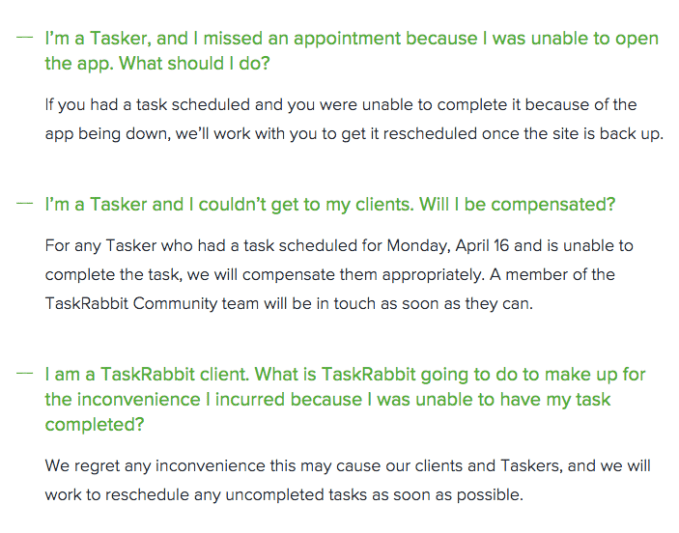
In response to a request for more information, TaskRabbit sent TechCrunch a statement that said active tasks will be rescheduled and taskers compensated for lost work. It also updated its landing page with a FAQ for users and taskers who unable to complete assignments today while the app is down:


from TechCrunch https://ift.tt/2qCFlGl

Judge says class action suit against Facebook over facial recognition can go forward

Whenever a company may be guilty of something, from petty neglect to grand deception, there’s usually a class action lawsuit filed. But until a judge rules that lawsuit legitimate, the threat remains fairly empty. Unfortunately for Facebook, one major suit from 2015 has just been given that critical go-ahead.

The case concerns an Illinois law that prohibits collection of biometric information, including facial recognition data, in the way that Facebook has done for years as part of its photo-tagging systems.

BIPA, the Illinois law, is a real thorn in Facebook’s side. The company has not only been pushing to have the case dismissed, but it has been working to have the whole law changed by supporting an amendment that would defang it — but more on that another time.

(Update: Although Facebook’s own Manger of State Policy Daniel Sachs co-chairs a deregulatory tech council in the Illinois Chamber of Commerce that proposed the amendment, the company maintains that “We have not taken any position on the proposed legislation in Illinois, nor have we suggested language or spoken to any legislators about it.” You may decide for yourself the merit of that claim.)

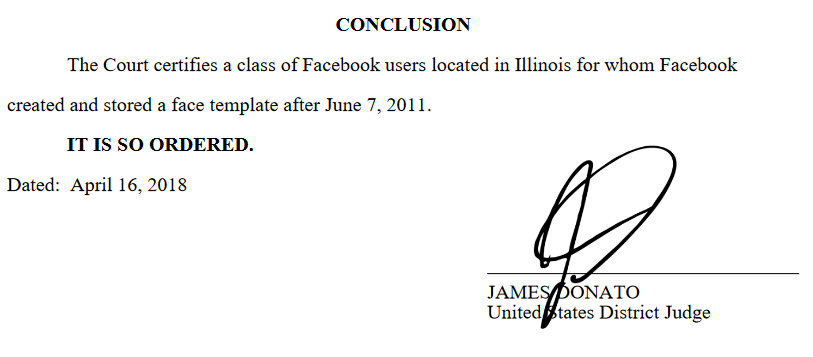
Judge James Donato in California’s Northern District has made no determination as to the merits of the case itself; first, it must be shown that there is a class of affected people with a complaint that is supported by the facts.

For now, he has found (you can read the order here) that “plaintiffs’ claims are sufficiently cohesive to allow for a fair and efficient resolution on a class basis.” The class itself will consist of “Facebook users located in Illinois for whom Facebook created and stored a face template after June 7, 2011.”

An earlier, broader class suggested by the plaintiffs included all Illinois users who appeared in a photograph on Facebook, but the judge, commendably, decided that this would include people who appeared in images but were not in fact recognized or recorded as face templates by the recognition systems. The more limited class will still amount to millions of people.

Facebook’s attempt to discredit the suit, quibbling over definitions and saying the plaintiffs “know almost nothing” about the systems in question, did not go over well with the judge. “The deposition testimony by the named plaintiffs shows a perfectly adequate understanding of the case, and it clearly manifests their concerns about Facebook’s treatment of personal biometric data,” he writes.

Its suggestion that no “actual” harm was caused also fails to hold water: “As the Court has already found, there is no question that plaintiffs here has sufficiently alleged that intangible injury.” Requiring “actual” injury would severely limit the reach of a rule like BIPA in Illinois, because, of course, the harm caused is one to one’s privacy and security, not to one’s body or wallet. Of course, the question of whether users consented to their “intangible injury” is yet to be settled, and may be a major crux in the case.

Facebook also tries the old chestnut of saying its servers aren’t in Illinois, so Illinois law doesn’t apply. “Contrary to Facebook’s suggestion,” writes Donato, “the geographic location of its data servers is not a dispositive factor. Server location may be one factor in the territoriality inquiry, but it is not the exclusive one.”

Lastly and most absurdly, Facebook argued that to establish legitimacy it would be necessary to check which users’ face templates were derived from scans of printed photographs instead of natively digital shots. “This too is unavailing,” says Donato, citing a total lack of evidence presented by Facebook.

When contacted for comment, Facebook provided a simple statement:

We are reviewing the ruling. We continue to believe the case has no merit and will defend ourselves vigorously.

The case will go ahead as ordered, though as before, at a snail’s pace.


from TechCrunch https://ift.tt/2H6PYYn

Nut allergy woman returns to Essex home after five years

Amy May Shead suffered a severe allergic reaction after being served a nut on a holiday to Budapest. from BBC News - Home https://ift.tt/2...